How I would use AI in Accounts Receivable: a 2,000-invoice test
Give AI the working context. Let it prepare the review. Keep investigation, coordination and decisions with finance.
An ageing might tell you that Customer A has ₹10m overdue. It does not tell you that sales agreed a credit note, the customer promised to pay next Friday, three invoices are disputed, or someone was meant to follow up last week.
That context normally sits across an ageing, a dispute tracker, collection notes, customer emails, sales inputs, meeting notes and people's heads. The useful role for AI is not to "do collections". It is to hold the supplied context together and prepare a more useful next review.
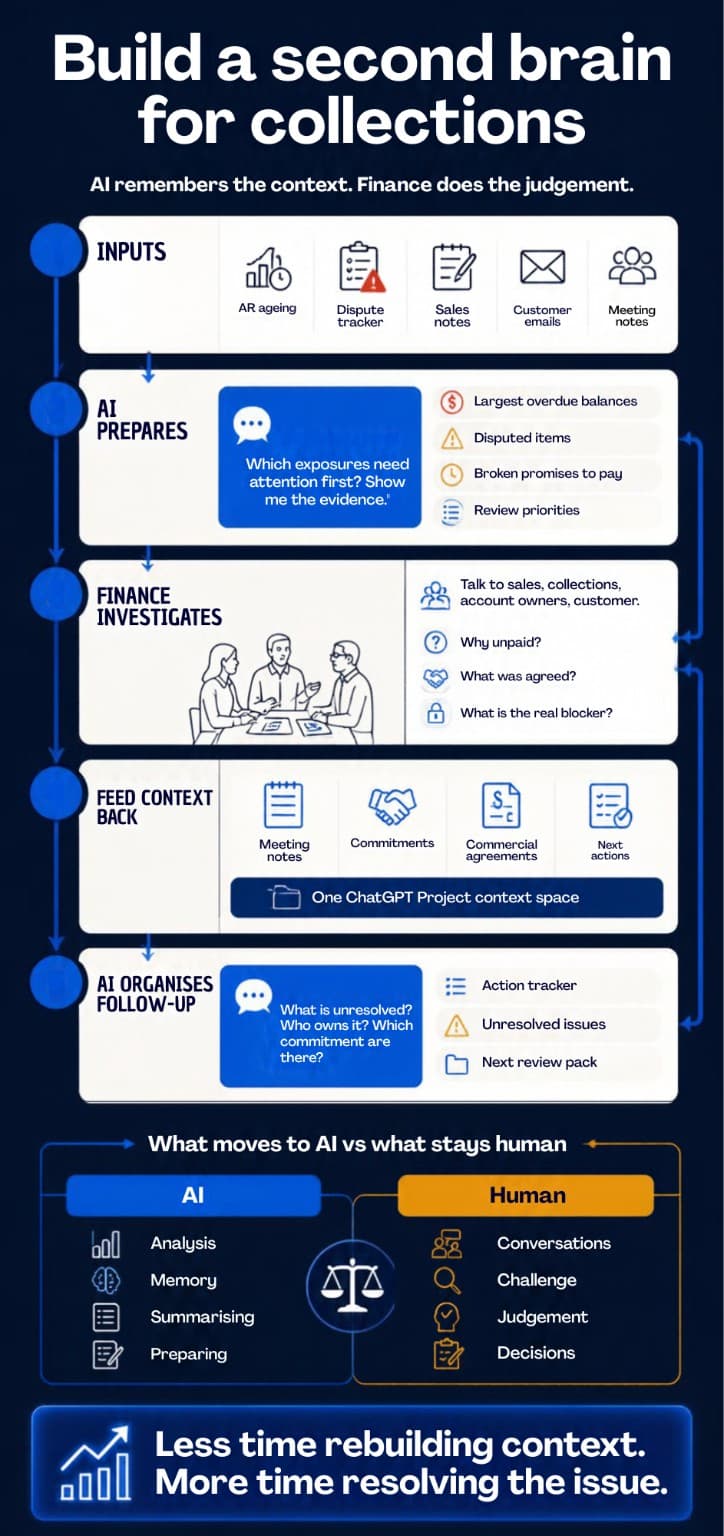
Use one Project as the working memory
Start a ChatGPT Project for the collections process. Upload the AR ageing, dispute tracker, collection notes and relevant sales inputs. As the review cycle develops, add meeting notes, customer commitments, commercial agreements and updated action trackers.
This boundary matters: AI only knows what has actually been provided to it. An ageing alone can show that an invoice is old. It cannot explain why it remains unpaid.
- Put the working information in one place. Begin with the ageing, dispute tracker, collection notes and sales inputs.
- Ask AI to prepare the collections review. It can rank exposures, identify broken commitments and surface the evidence from the supplied files.
- Investigate as finance. Speak to sales, collections, account owners and customers. Review the commercial arrangement. Challenge the explanation. Agree the next action.
- Feed the new context back in. Add the notes and updated files, then ask AI to organise what remains unresolved before the next review.
Ask AI to prepare, not guess
Which customer balances need attention first? Show me the evidence from the files.
With the workbook below, the next questions can be more specific:
- Which customers have the largest overdue exposures?
- Which balances are more than 90 days overdue?
- Which overdue invoices are disputed?
- Which promises to pay have passed?
- Where is exposure concentrated by customer?
The prompt pack includes controlled versions of these questions. Each asks the model to show the supporting columns and filters, rather than give a confident but untraceable conclusion.
What remains a finance job
AI may identify a large overdue invoice. It cannot know the real reason for non-payment unless the supporting context exists in the Project. Finance still needs to speak to sales, understand the dispute, contact the customer, challenge an explanation, negotiate the path forward and decide what should happen.
AI
- Analyse
- Organise
- Remember
- Summarise
- Prepare
- Track
Finance professional
- Investigate
- Speak to stakeholders
- Challenge
- Negotiate
- Judge
- Decide
AI does the remembering. Finance does the resolving.
After the review, close the loop
Add the meeting notes and the updated files to the Project. Then use the same context to prepare the next review instead of rebuilding the story from scratch.
What is still unresolved? Who owns each action? Which commitments are overdue?
Other useful prompts:
- Summarise what changed since the previous review.
- Which customer explanations conflict with the underlying invoice data?
- Show open actions with owner, due date and supporting evidence.
- Prepare the agenda for the next collections review.
- Draft a management summary using only evidence contained in the uploaded files and notes.
The 2,000-invoice test dataset
The workbook is synthetic and contains no company or client data. It is designed to make the outputs checkable against individual invoice rows, not to simulate a real client portfolio.
Total open receivables
90+ days overdue, or 30.5% of open AR
Overdue disputed balances
Balances with passed promise-to-pay dates
Control figures calculated from the supplied workbook as at 30 September 2026. A result that does not reconcile back to these figures should be investigated before it is used.
Download the lab files
AI for Finance Labs
This is the first in a possible series of practical finance labs. Future labs may cover audit support, financial statement variance analysis, bank reconciliation, accrual review and month-end close.