AI Agents Need a Delegation of Authority, Not Just Intelligence
As AI agents gain roles, permissions and recurring costs, finance needs to govern their purpose, authority and accountability.
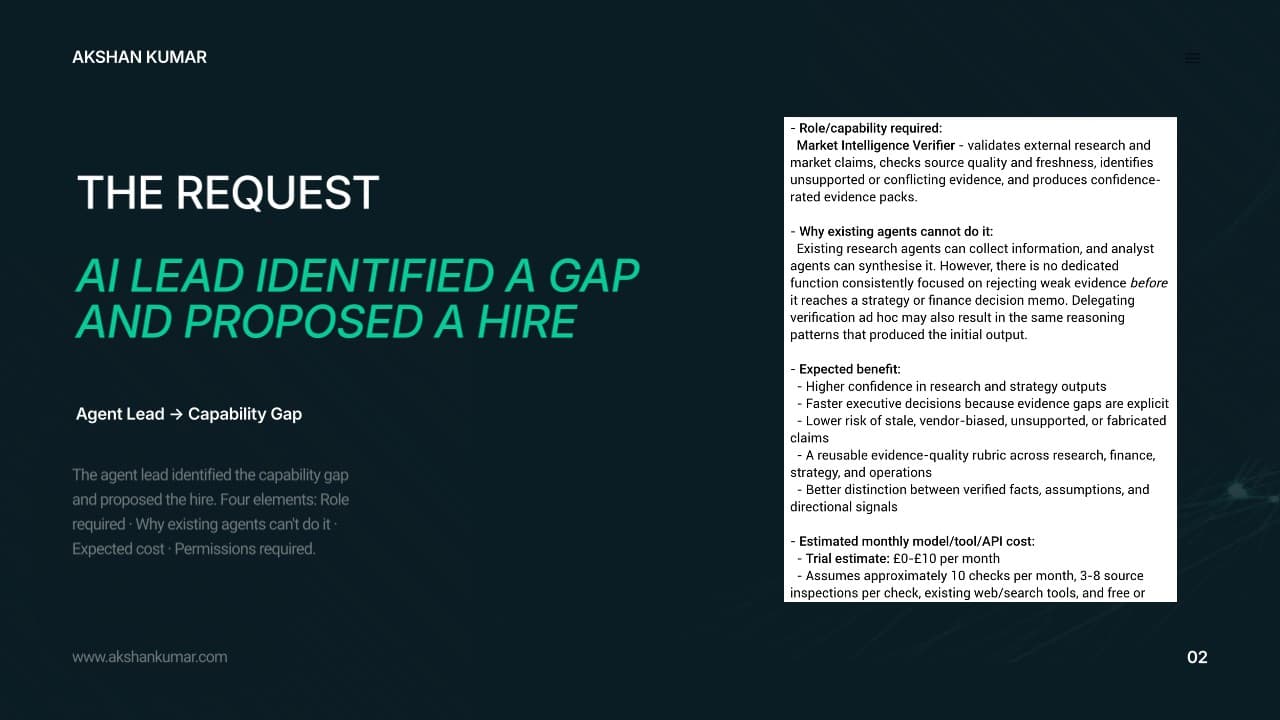
An AI manager in my experiment asked to hire another AI agent.
The request was sensible. It explained the capability gap, why the existing agents could not do the work, the expected benefit, the permissions required and the estimated ongoing cost.
Then the interesting question appeared: who gets to approve the hire?
This is not only a technical question. It is a finance and operating-model question.
As organisations move from one-off AI tools towards teams of agents, they will need to make familiar decisions about role design, cost, authority, access and accountability. The technology is new. The management disciplines are not.
An AI workforce needs controls around it
In a conventional organisation, a manager identifies a headcount need. Finance reviews the economics. A senior owner approves the commitment. System access and authority are then defined.
The equivalent model for an AI workforce is straightforward:
- A manager agent can identify a capability gap and make the business case.
- A CFO agent can assess expected usage, cost and resource trade-offs.
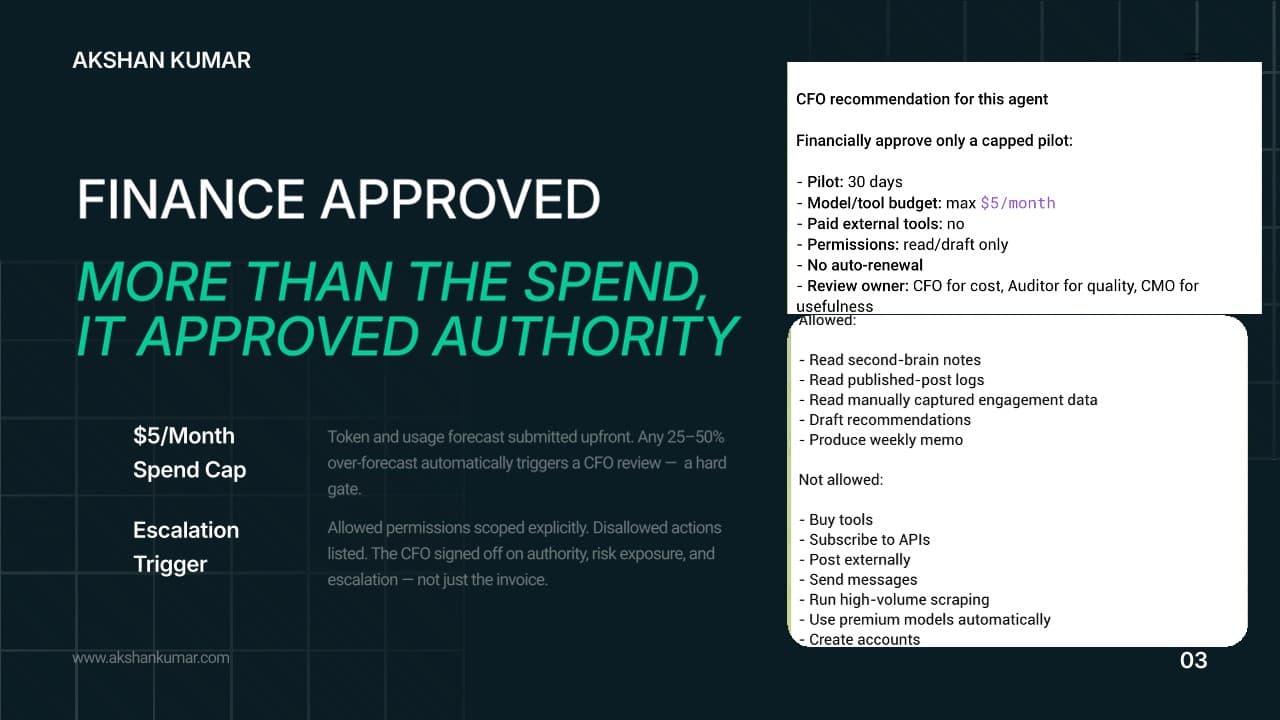
- A human owner approves a new recurring cost or consequential capability.
- Access, spending limits and escalation points are defined before the agent operates.
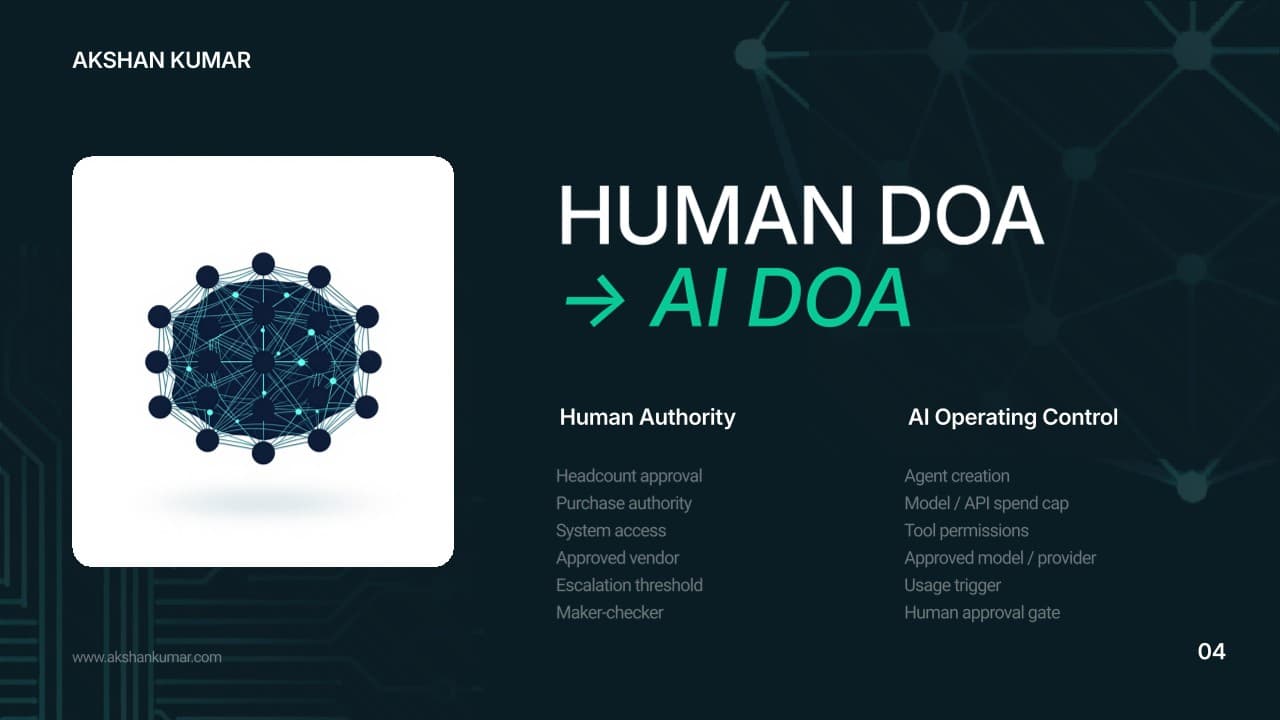
This is a Delegation of Authority matrix applied to AI agents.
It makes authority visible. It does not mean every task needs human intervention. An agent can still research, assemble evidence, prepare a recommendation and draft a decision. The control boundary matters when it can create a cost, access a sensitive system, commit the organisation or take an irreversible action.
Finance should approve authority, not only spend
The cost of an AI agent is only part of the decision.
Finance also needs to ask what the agent is permitted to do. Can it access an ERP or procurement system? Can it use a paid model or API? Can it create another agent? What happens if its actual use materially exceeds the forecast? Who reviews its output?
These questions have direct equivalents in established finance controls:
- Headcount approval becomes agent creation.
- Purchase authority becomes model and API spend limits.
- System access becomes tool permissions.
- Approved vendors become approved models and providers.
- Escalation thresholds become usage or cost triggers.
- Maker-checker controls become human approval gates.
The practical point is simple: the CFO should not merely approve an AI budget. Finance should help design the economic and authority model around the AI workforce.
Specialisation must earn its place
There is a genuine case for specialist agents. A single general agent can accumulate too much instruction, context and too many tools. A well-designed specialist can own a narrow task, work with clearer boundaries and produce a more reliable result.
But specialisation can also create agent sprawl.
In my early experiment, I created 21 agent profiles. Seventeen had not done meaningful work. Creating an AI role is easy; creating a useful one is not.
Every AI role should therefore be able to answer a few basic questions:
- What recurring work does it own?
- Can an existing agent do this adequately?
- Does specialisation improve the result enough to justify its cost?
- What authority and systems does it actually need?
- How will its use, quality and cost be reviewed?
- When should the role be redesigned, paused or retired?
That is workforce planning. It applies whether the worker is a person, a service provider or an AI agent.
Start with a practical AI Delegation of Authority
Organisations do not need a complex AI governance programme before they begin experimenting. They do need a clear operating boundary.
Start with these seven controls:
- Give every agent a named business owner.
- Define the business purpose and measurable outcome for each role.
- Limit system access and tool permissions to what the role needs.
- Set model, API and other spending caps.
- Require approval before an agent creates a new recurring cost or role.
- Set usage, cost and confidence triggers that require review.
- Retain a human approval gate for consequential decisions and actions.
The details will differ by process. An agent drafting variance commentary presents a very different risk from one that can create a purchase order, post a journal or release a payment. The authority model must reflect that difference.
The CFO role in AI will be broader than budget approval
The future question is not simply whether AI agents can do work. It is whether organisations can manage them as part of the operating model.
Someone needs to govern AI capacity, utilisation, cost, authority and return. Someone needs to decide when a new role is justified. Someone needs to know who is accountable when an agent acts outside its intended boundary.
That is why the CFO's role in AI may become much larger than approving the technology budget.
The most useful place to begin is not an impressive AI organisation chart. It is a clear set of controls around purpose, authority, limits, human approval and accountability.
For the wider operating model, see the deterministic-versus-agentic finance framework, applied AI use cases and human control points, continuous controls monitoring in finance, and the finance transformation operating-model guide.
Questions worth asking before an agent is given a role
Can an agent create another agent?
It can make the case. A human owner should approve the new role, its recurring cost and the authority it will receive before anything is created.
What should be set before the agent starts?
Its purpose, the systems it can use, the actions it cannot take, the spending limit, the escalation route and the person who reviews the work. These are ordinary management disciplines applied to a new kind of worker.
What happens when the agent gets something wrong?
It should stop at the defined boundary, preserve the record of what it did and hand the item to a named person. A useful control does not assume mistakes will never happen; it makes them visible and manageable.
The free AI Control Set for Finance includes the control register, threshold register and sign-off gate needed to put these decisions into a working process.
Read the original LinkedIn post: My AI manager asked to hire another AI agent
Read the earlier LinkedIn post: Building an organisation of AI agents
This article reflects a personal practical experiment. It is not a client deployment or a production operating model.